Reviewing Pfas claims in Big Brands…
No More Forever Chemicals · · · 3 min read
Key takeaways
- Last update, we admitted a problem with our own work: every brand we'd audited was premium or transparency-positioned.
- We expected the worst claims yet. "PFAS-free" splashed across a product page with nothing behind it.
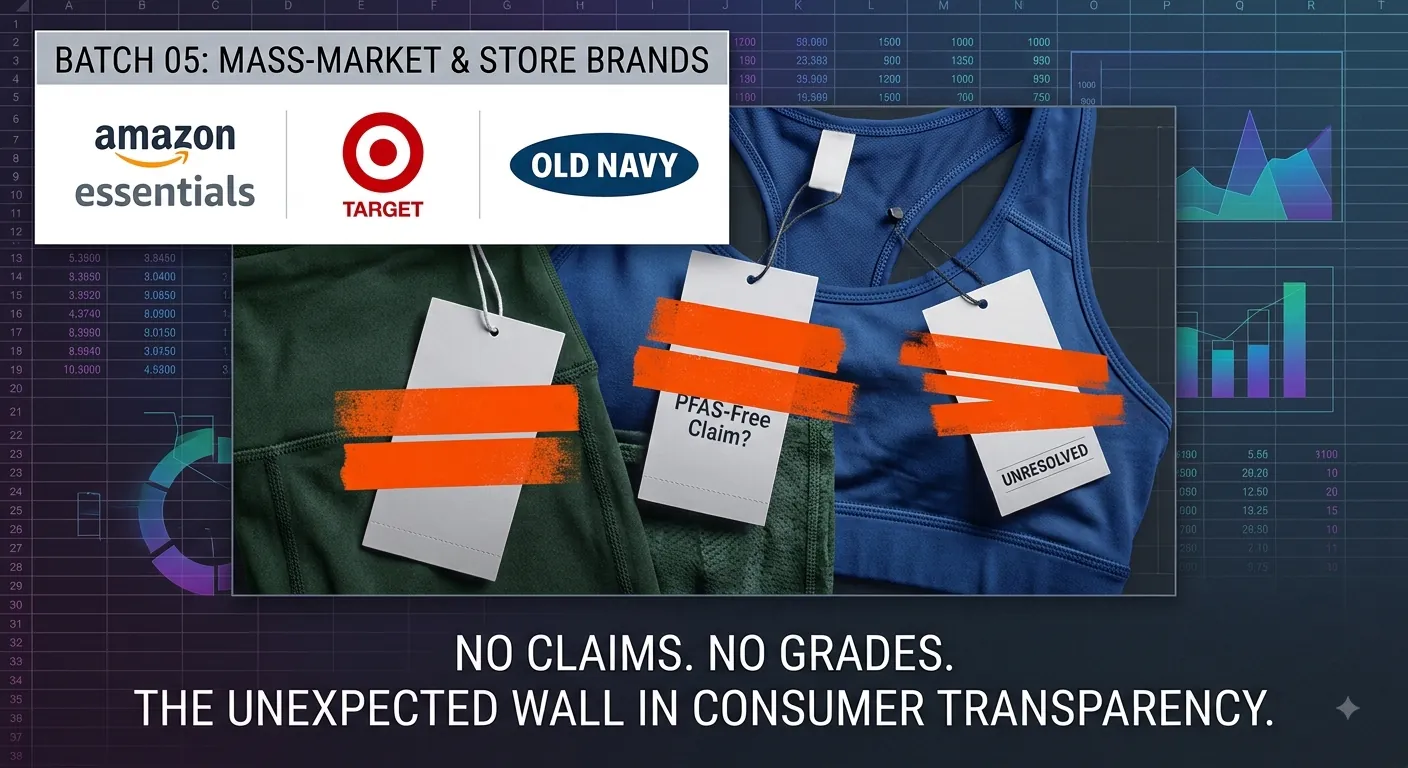
- Instead we hit a wall we didn't anticipate: we couldn't reliably find the claims at all.
Hi —
Last update, we admitted a problem with our own work: every brand we'd audited was premium or transparency-positioned. That's a real bias. So we went down-market — mass-market activewear, store brands, the things most people actually buy.
We expected the worst claims yet. "PFAS-free" splashed across a product page with nothing behind it.
Instead we hit a wall we didn't anticipate: we couldn't reliably find the claims at all.
Three brands, unresolved
Of five brands in this batch, three ended the session with no grade. Not because they scored badly — because we couldn't locate a PFAS-free claim on their own websites, and we couldn't complete the search thoroughly enough to say for certain that none exists.
That distinction matters, so let's be precise about it. There are two different situations, and only one of them is a finding:
A brand makes no PFAS-free claim. Under our rules, that's out of scope entirely. We audit claims. No claim, nothing to audit. Not a failing grade.
We didn't finish looking. That's not a finding about the brand. That's an incomplete audit, and it stays open until we finish.
All three of these are in the second category right now. We're not going to publish "this brand makes no claim" on the strength of a search we know we didn't complete. They're logged as unresolved, and they stay that way until someone has gone through every materials page, product page and FAQ properly.
But the pattern is already visible
Even with three rows open, the shape of this batch was different from everything before it, and it's cleaner than we expected:
Premium and wellness-positioned brands claim loudly and publish thin evidence. They put "PFAS-free" in the marketing because that reassurance is part of what you're paying for.
Mass-market and store brands often publish detailed chemical policies instead. Restricted substance lists. Supplier requirements. Dated elimination commitments. Documents written for regulators and watchdog scorecards — not marketing written for shoppers.
One large retailer's store brand had a dated, specific commitment on chemical finishes in textiles, with public restricted-substance documentation behind it. It earned a C — the same grade as brands with far louder marketing. It simply never converted the policy into a claim on a product page.
The result that broke our own system
One brand in this batch was independently tested by a third party. An EPA-certified lab found no detectable organic fluorine in the product tested. A clean result.
And that brand may not be eligible for our index at all — because we can't find where it advertises itself as PFAS-free.
Sit with that. A brand with a genuine clean lab result gets nothing from us, because we score what companies claim and what they publish to back it up. Say nothing, and you're invisible to a claims audit.
That's a real limitation of what we're building. It's going into our published limitations section, not getting quietly smoothed over.
What we're changing because of it
Our spreadsheet had columns for evidence that contradicts a brand's claim. It had nowhere to record third-party testing that supports one.
That's backwards. Two brands in this batch have clean independent results, and a dataset that only tracked evidence against companies would deserve every criticism it got. We're adding supporting-evidence columns before another row gets entered.
That's the fourth structural fix that came out of auditing rather than theorizing — and every one landed before we locked a single final score. Which is the entire reason we wrote the methodology first and scored second.
Where the number stands
Fourteen brands scored. Two B's, twelve C's. Three rows open.
Still zero A's.
That's now held across premium cookware, direct-to-consumer activewear, technical outdoor gear, mass-market apparel and private label. Fourteen brands, five very different segments, and not one publishes a dated third-party lab report a shopper can actually open.
And the thing that hasn't changed
None of these grades mean a product contains PFAS. Some brands we've graded low are almost certainly selling exactly what they say. The grade measures what you can verify — not what's in the fabric.
We'll keep repeating that. We'd rather be tedious than misleading.
More soon,
No More Forever Chemicals